

Sense.ADC.6
Betasix-channel analog input
Sense.ADC.6 turns six analog inputs into calibrated millivolt readings served over I2C, so a host reads voltages instead of managing an ADC. All sampling, filtering and timing happen on the tile. It sweeps the six channels continuously at a paced rate and publishes a filtered set at a configurable output rate, 100 Hz by default.
Every published set is coherent: all six channels come from the same instant, never a mix of old and new, and each set carries a sequence number so a host can tell a fresh reading from a repeat. Readings span 0 V to the tile's own supply and are calibrated against an internal reference, so they track the rail rather than assuming it. The supply is readable too, which doubles as the full-scale value.
Inputs accept source impedances up to roughly 30–50 kΩ. Output rate (1–250 Hz), sweeps averaged per period (1–32), and filter-window length are all settable at runtime and can be stored on the tile to survive reboot.
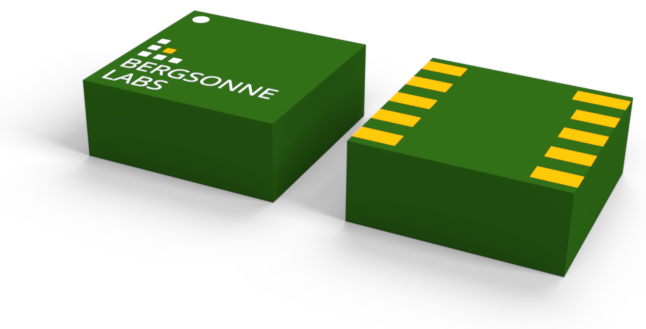
Technical Summary
- Package
- T44-10
- Drawing
- Land pattern (PDF)
- Packaging
- 12mm tape and reel (drawing)
- Power
- 1.8–3.6V
- Component
- Core.ST.L0.1
- Interfaces
- I2C
Resources & Links
- Datasheet
- Coming soon
- JSON Tile Definition
- v0.6 (Sep 22, 2026)
- Drivers
- Documentation|GitHub
Configuration
- I2C address
- 0x28 (default)0x290x2A0x2B
- Output rate
- 10 Hz (nulls 50 and 60 Hz)50 Hz100 Hz (default)120 Hz (pairs with 60 Hz rejection)200 Hz
- Sweeps averaged per period
- 48 (default)1632
- Averaging window
- One output period (fastest response)Two output periods (nulls half the output rate: 50 Hz at 100 Hz out)
Application Notes
I2C address
The I2C address is stored on the tile and changeable across 0x08–0x77, so several tiles can share one bus; it ships at 0x28.
Filtering
Filtering is a boxcar average whose window is set in output periods, which doubles as mains rejection: a two-period window nulls 50 Hz at a 100 Hz output, or 60 Hz at 120 Hz, and a 100 ms window nulls both
Polling
Poll a little faster than the output rate, two to three times, and use the sequence number to discard repeats. The tile's clock and the host's drift apart by about a percent, so polling at exactly the output rate will occasionally read the same set twice or miss one.
Pad Assignments
| Pad | Type | Function | Note | |
|---|---|---|---|---|
| 1 | ⏻ | GND | ||
| 2 | A | CH0 | ||
| 3 | A | CH1 | ||
| 4 | D | I2C.CLK | ||
| 5 | D | I2C.DAT | ||
| 6 | A | CH2 | ||
| 7 | A | CH3 | ||
| 8 | A | CH4 | ||
| 9 | A | CH5 | ||
| 10 | ⏻ | V+ |
I2C
I2C- Mode
- slave
- Max Clock
- 400kHz
- Addresses
- 0x28(default),
- Format
- —
| Function | Required | Pad(s) |
|---|---|---|
| I2C.CLK | Yes | 4 |
| I2C.DAT | Yes | 5 |
Development Product — This is an electronic development module intended for evaluation, prototyping, and integration into other designs by qualified engineers and developers. It is not a finished consumer product and has not been independently certified for FCC, CE, UL, or other regulatory compliance. The integrator of this module into a finished product is responsible for obtaining all necessary certifications. Not intended for use in life-support systems, safety-critical applications, or any application where failure could result in personal injury or property damage.