

Sense.CAM.P
Betamonochrome QVGA camera
An ultra-low-power machine-vision tile built around the PixArt PAG7920J3, a 320 × 240 monochrome global-shutter camera module with an integrated lens. It captures 8-bit RAW frames at up to 180 fps over SPI, with 3.0 µm pixels, a 71.3° × 53.7° field of view, and 64 dB of dynamic range. Configuration is over I2C. A proprietary on-chip motion-detection mode draws under 100 µW (compared to 760 µW for QVGA output at 15 fps) making the tile practical to leave always-on in a battery-powered system, with auto exposure and gain control, auto black cancellation, mirror/flip, windowing, LED strobe, and multi-sensor frame sync built in.
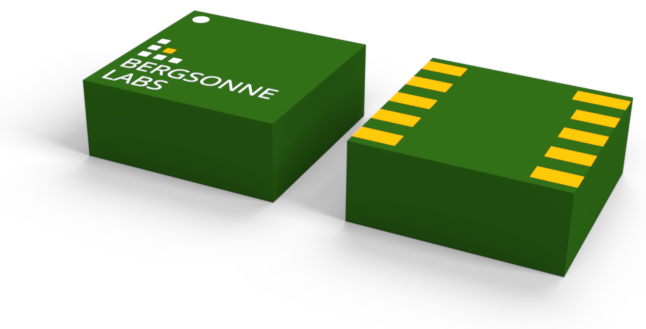
Technical Summary
- Package
- T44-10
- Drawing
- Land pattern (PDF)
- Packaging
- 12mm tape and reel (drawing)
- Power
- 1.8–3.3V
- Component
- PAG7920J3 (PDF)
- Interfaces
- I2CSPI
Resources & Links
- Datasheet
- Coming soon
- JSON Tile Definition
- v0.7 (Aug 10, 2026)
- Drivers
- Documentation|GitHub
Application Notes
I2C address
when GPIO2 (pad 3) is left floating, the I2C address will default to 0x35. Pulling GPIO2 (pad 3) high will change the address to 0x25, while grounding pad 3 will set it to 0x40. The camera will also respond to general broadcasts on 0x60.
Pad Assignments
| Pad | Type | Function | Note | |
|---|---|---|---|---|
| 1 | ⏻ | GND | ||
| 2 | D | GPIO1 | ||
| 3 | D | GPIO2 | ||
| 4 | D | I2C.CLK | ||
| 5 | D | I2C.DAT | ||
| 6 | D | SPI.MISO | ||
| 7 | D | SPI.CLK | ||
| 8 | D | SPI.CS | ||
| 9 | D | SPI.MOSI | ||
| 10 | ⏻ | V+ | 1.8-3.3V |
I2C
I2C- Mode
- slave
- Max Clock
- 1MHz
- Addresses
- 0x35(default), 0x25, 0x40
- Format
- 7-bit address
| Function | Required | Pad(s) |
|---|---|---|
| I2C.CLK | Yes | 4 |
| I2C.DAT | Yes | 5 |
| GPIO2 | No | 3 |
SPI
SPI- Mode
- slave
- Max Clock
- 25MHz
- Address
- —
- Format
- —
| Function | Required | Pad(s) |
|---|---|---|
| SPI.MISO | Yes | 6 |
| SPI.CLK | Yes | 7 |
| SPI.CS | Yes | 8 |
| SPI.MOSI | Yes | 9 |
Development Product — This is an electronic development module intended for evaluation, prototyping, and integration into other designs by qualified engineers and developers. It is not a finished consumer product and has not been independently certified for FCC, CE, UL, or other regulatory compliance. The integrator of this module into a finished product is responsible for obtaining all necessary certifications. Not intended for use in life-support systems, safety-critical applications, or any application where failure could result in personal injury or property damage.